Crypto Volatility Revives Templeton Principle as Traders Face Emotion-Driven Losses
TokenPost.ai
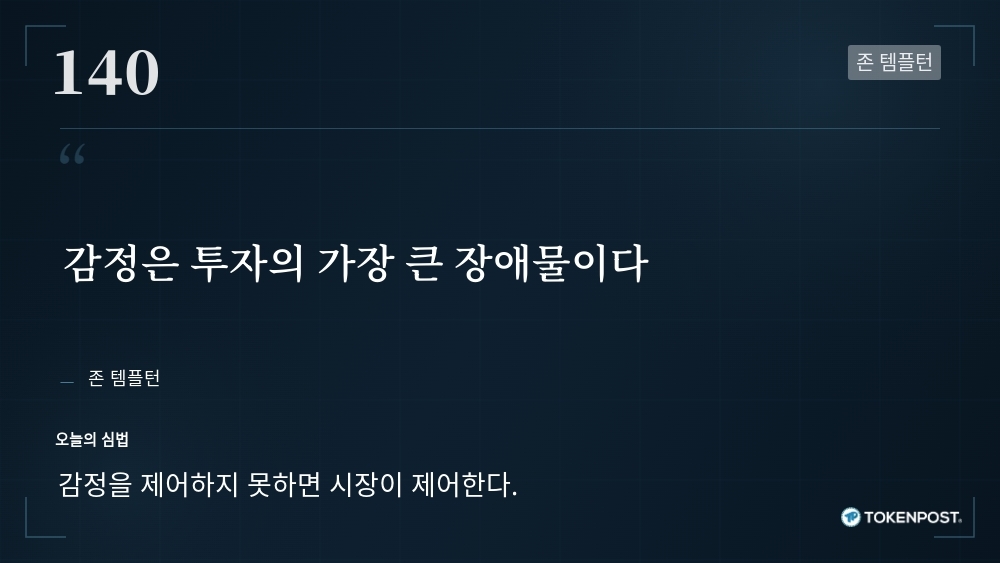
Veteran investor John Templeton’s maxim—“Emotion is the investor’s greatest enemy”—is resurfacing among crypto traders as the market continues to swing between risk-on rallies and sharp pullbacks, amplifying the cost of impulsive decision-making. The message is less about predicting the next move in Bitcoin (BTC) or altcoins and more about how ‘emotional control’ can determine whether losses remain manageable or spiral into portfolio-damaging drawdowns.
The core distinction between professionals and amateurs, according to the Templeton school of thinking, is not the number of winning trades but the magnitude of losing ones. In practice, disciplined risk management—such as adhering to a predetermined stop-loss level—can dramatically reduce the size of a setback. When traders abandon those rules in the heat of a sudden spike or selloff, they often allow the market to dictate their behavior rather than the other way around, turning routine volatility into outsized losses.
Templeton (1912–2008) is widely regarded as a pioneer of global investing and a defining figure in ‘contrarian investing.’ Through the Templeton Growth Fund, he recorded roughly 15% average annual returns over 38 years, cementing a reputation built on patience, diversification, and a willingness to buy when sentiment was darkest. His most famous episode dates to 1939, on the eve of World War II, when he reportedly purchased 104 U.S. stocks at a time when panic dominated the market—an act that later became an enduring legend in financial history.
His guiding principle, “Buy at the point of maximum pessimism,” has particular resonance in crypto, where sentiment can flip rapidly as traders react to liquidity conditions, regulatory headlines, and macroeconomic signals. In these environments, fear-driven capitulation can coincide with periods of depressed valuations, while euphoria can tempt late entries at stretched prices—both outcomes rooted in emotion rather than process.
The broader takeaway for today’s digital asset market is straightforward: volatility is inevitable, but the damage it causes is often optional. As crypto continues to mature and attract a wider spectrum of participants, Templeton’s reminder serves as a timely lens on the difference between surviving turbulent markets and being controlled by them—especially when confidence and panic take turns setting the tone.
Article Summary by TokenPost.ai